| IEEE | F. Rola, M. Matos, M. Nazarewicz, and P. Romano, “SpecPool: Storage-Layer Speculation for Parallel Smart Contract Execution,” 2026 46th IEEE International Conference on Distributed Computing Systems (ICDCS), Seoul, South Korea, June 2026, pp. 1290–1300, doi:10.1109/2575-8411.2026.00126 I’m pleased to share the ‘SpecPool: Storage-Layer Speculation for Parallel Smart Contract Execution’ paper which I’ve co-written. It introduces a mechanism for parallel speculative smart contract execution at the mempool stage. With improvements of consensus protocols and increased computation demands on blockchains, the transaction execution time becomes blockchain’s bottleneck. SpecPool predicts a likely transaction block order and executes smart contracts available in mempool while they await consensus. Once the final block order is established, SpecPool validates each execution maximising concurrency while preserving consensus-consistent ordering. Operating at the storage layer, SpecPool requires no modifications to virtual machine semantics or consensus protocols, simplifying adoption in existing blockchain systems. Experiments on the Injective blockchain demonstrate up to a 60× reduction in block validation latency and 20% throughput improvement over prior parallel execution approaches The SpecPool paper can be accessed through the IEEE Xplore site or the author copy (PDF, 422 kB).This article continues the series about approximating circles using Bézier curves. Preceding parts analysed linear and quadratic curves. This entry examines cubic Bézier curves. It presents a construction of a spline which approximates a circle and derives practical formulæ based on different optimisation criteria. Table of Contents
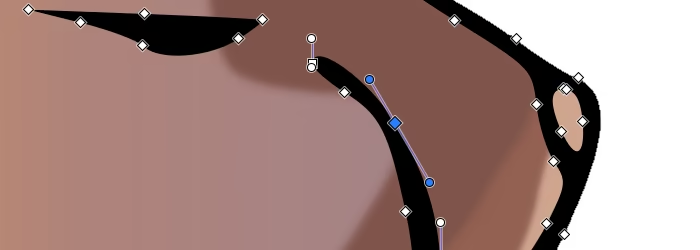 Fig. 1 Inkscape highlighting a joint (a blue diamond) and adjacent control points (blue circles). Fig. 1 Inkscape highlighting a joint (a blue diamond) and adjacent control points (blue circles). Cubic Bézier curves are available in many popular tools. They are widely used in vector graphics editing and animation software, and provide flexibility while remaining intuitive to edit. For example, Fig. 1 presents Inkscape’s Node Tool highlighting a joint and two control points adjacent to it. Dragging the points offers a user-friendly way to modify the shape. A cubic Bézier curve uses four control points: \(\def\P{\mathbf P}\P_0\) through \(\P_3\) and is defined by the following parametric function: $$\def\tau2k{\frac τ{2k}} \def\D{Δ\mathbf P} \def\O{\mathbf O} \def\R2{\mathtt{R2}} \def\V{\mathbf V} \def\VR{\mathbf V^⟂} \def\argmin{\operatorname*{arg\,min}} \def\lerp{\operatorname{lerp}} B(t)=(1-t)^3\P_0 + 3(1-t)^2t\P_1 + 3(1-t)t^2\P_2 + t^3\P_3$$ 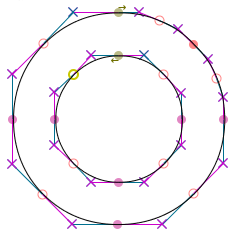 Fig. 1 An outline of a degree symbol from DejaVu Sans font. Fig. 1 An outline of a degree symbol from DejaVu Sans font.The previous article in the series explored drawing circles with linear Bézier curves. This article continues by showing how to use quadratic curves. Table of Contents
A quadratic Bézier curve uses three control points. The first and last points are the endpoints, while the middle one provides control over the curve’s shape. This additional control lets quadratic curves approximate curved shapes more accurately. Although they’re less expressive than higher-order curves, quadratic curves are widely used thanks to their balance of computational complexity and shape control — most notably in computer fonts (see Fig. 1) where the relative simplicity enables efficient rendering algorithms.1 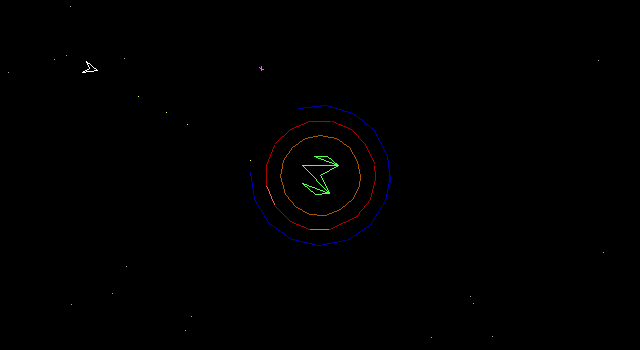 Fig. 1 Star Castle video game draws circles as regular polygons. (Click to open the image). Fig. 1 Star Castle video game draws circles as regular polygons. (Click to open the image).Some systems do not provide a circle primitive; in those cases, circles need to be approximated using different shapes. For example, many fonts are limited to quadratic Bézier curves,1 and even though Adobe Animate includes a circle tool, it represents circles using cubic Bézier curves instead.2 Such approximations are common in video games as well (see Fig. 1), where round objects still present rendering challenges. This post is first in a series of articles about approximating circles. It introduces linear Bézier curves, and how to approximate a circle using linear Bézier curves. The next two articles cover quadratic and cubic curves, which produce progressively smoother results. Table of Contents
Recent carykh’s Adobe Animate’s circles aren’t real circles video demonstrates how Adobe Animate approximates circles with Bézier curves. At the end of the video Cary demonstrated what happens to the shape if control points are pushed to extreme, but using imprecise mouse manipulation, the effect wasn’t quite precise. The effect can be achieved with SVG1 quite easily and so I present it below:Demonstration of a circle approximated via eight cubic Bézier curves as the handles are pushed to extreme way past when the shape resembles a circle. The graphic includes a purple circle; a red octagon inscribed in the circle; and a green spline which consists of eight cubic Bézier curves with anchor points in vertices of the octagon. As I looked more into the subject I’ve decided to write a full series about approximating circles with Bézier curves with different degrees. The subject is more complex than one might imagine and it wouldn’t quite fit as a single post. That’s why I’ve decided to split it into multiple articles with this post acting as a table of contents: - ‘Drawing circles with polygons’ which turns out to be more involved with more than one way of doing it. I will also present mathematically ‘best’ way to draw a polygon so that it resembles circle the most.
- ‘Drawing circles with quadratic Bézier curves’ with discussion of smoothness and mathematical derivation of the best parameters to use depending on number of segments in the curve.
- ‘Drawing circles with cubic Bézier curves’ which allow for more degrees of freedom and thus looking at more constraints and trade-offs in drawing a circle approximation.
Introduced last century, favicons help users identify tabs in a crowded browser. Originally limited to the ICO format, they can now leverage Scalable Vector Graphics (SVG). This vector format not only scales perfectly to different sizes but also unlocks dynamic features which this article explores, namely: When Linux desktop adoption is discussed, some point out the lack of graphical user interfaces (GUI) and the necessity of using command-line interface (CLI) tools or editing text files as a reason more people don’t use Linux-based systems. Such characterisation misses how much Linux has changed. The notion that the terminal is a major barrier is outdated and ignores the fact that most users never need to touch it. An assertion that users should not need the terminal for common tasks is different from a claim Linux distributions lack GUIs. The GoodFirst, let’s recognise how Linux has improved. In the ’90s and ’00s one had to manually edit cryptic modelines to get their display working. A mistake could lead to a damaged monitor. Nowadays, the main complication is picking a distribution which includes Nvidia drivers. And that’s not the only thing that has changed. Installing software often required interacting with the CLI; now graphical software managers — which work not unlike app stores many users are familiar with — are common. Handling WiFi used to require messing with wpa_supplicant; now it’s done through an icon in the system tray. Bambu Lab, a company once celebrated for its high-quality and user-friendly 3D printers, has recently hit a trifecta of questionable behaviour: enshittification of their products, threatening legal action to silence critics and violation of free software licences. Fortunately, several organisations have stepped in to fight for customer rights and free software. Among those, Software Freedom Conservancy (SFC) is asking for volunteers and donations to help fight Bambu’s corporate overreach. It is unclear why Americans write dates in month-day-year format. What is clear is that it makes little sense and differs from the way most of the world writes dates resulting in confusion. While human puzzlement is well-documented (something I’ve written about as well), equally critical is how screen readers and machine translation behave. When handling dates in a free-form text, software relies on fragile heuristics. For example, DeepL and Google Translate decide seemingly randomly whether to treat dates the British or American way as demonstrated on figure below. The behaviour can change depending on the use of padding zero, existence of other dates in the translated fragment or surrounding text.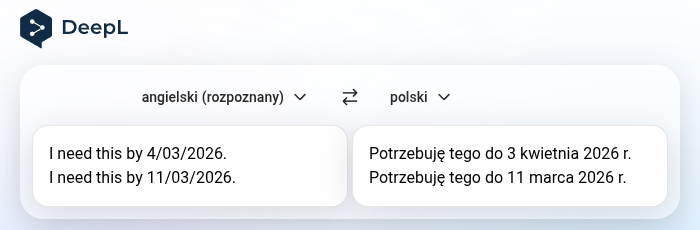 | BibTeX | @article{Nazarewicz2026ntp,
title = {{NTP}-over-{HTTP}},
author = {Michał Nazarewicz},
journal = {{Paged Out!}},
year = 2026,
month = feb,
number = 8,
pages = 40,
url = {https://pagedout.institute/webview.php?issue=8&page=40}
} |
|---|
| ACM | Michał Nazarewicz. 2026. NTP-over-HTTP. In Paged Out!, 8 (February 2026), 40. https://mina86.com/2010/dni-wolnego-oprogramowania/ |
|---|
| APA | Nazarewicz, M. (2026). NTP-over-HTTP. Paged Out!, 8, 40. https://pagedout.institute/webview.php?issue=8&page=40 |
|---|
| IEEE | M. Nazarewicz, „NTP-over-HTTP,” Paged Out!, № 8, p. 40, Feb. 2026. [Online]. https://pagedout.institute/webview.php?issue=8&page=40 In case you’ve missed it, issue #8 of the Paged Out! magazine is out. Marking that occasion, I thought I’d share my ntp-over-http Rust implementation which was featured there. Did you ever need to synchronise a machine’s time without access to NTP (maybe because of a blocked port)? That’s exactly what the tool can help with. $ cargo install ntp-over-http
…
$ ntp-over-http
ntp-over-http: https://qwant.com/
2026-03-27 17:08:42 UTC For more details, caveats and other approaches, have a look at the NTP-over-HTTP article in the magazine.The previous article covered how to create a custom font with a chosen SVG image. While icon fonts are convenient for visual presentation, they can create accessibility challenges. For example, if the font isn’t loaded — whether due to browser settings or temporary network glitch — users are left with an unappealing missing character symbols. Additionally, screens may announce a cryptic symbol name when reading the web page, confusing users. This article describes a method of addressing those issues through the use of ligatures. It’s building on the previous tutorial and assumes the custom icon font has already been created. The advent of web fonts popularised the use of icon fonts, i.e. fonts that consist solely of symbols and images rather than letters. Icon fonts such as Pictos, Font Awesome and Lucide have become well-known alternatives to image sprites, offering greater convenience and versatility. However, despite the abundant choice, pre-made sets don’t always meet the requirements of a specific website. This article demonstrates how to create a custom icon font using FontForge. It describes the steps of importing an SVG image into a glyph in a web font. A tailor-made font lets you select icons that perfectly match your website’s needs.  CMYK is a subtractive colour model commonly used in printing. Letters in the acronym stand for the four colours used in the model: Cyan, Magenta, Yellow and… uhm… blacK? The myth goes that using ‘B’ for black would be confusing (on account of blue and brown existing), so powers that be decided to use the last letter of the word ‘black’ in the acronym. This is not quite true. In fact, K in CMYK stands for Key or Key Plate. A decade ago, I had the pleasure of organise DressCode — an online competition designed spark teenage students’ interest in computer science. Its participants completed a series of programming challenges one of which was to implement a few sorting algorithms. To make it more engaging, I’ve created a JavaScript harness which visualised the algorithm by animating a clowder of longcats. Feedback was positive, I was told, with students appreciating the visual element. I’ve finally dusted off and updated the code hoping it will be useful to, for example, computer science teachers. After all, learning sorting algorithms through an interactive animation is more engaging than working with static lists of numbers. Following video shows that animation which can also be seen live. I’ve previously written about escaping special characters in HTML using character entities. This article discusses another method of achieving a similar result: CDATA sections. It explains what CDATA is, how it’s used in XML, SVG, MathML etc., when it can be included in HTML5 file and how it impacts XHTML. What is CDATA?A CDATA section in an XML document instructs the parser to interpret the enclosed text literally, as pure character data, not as markup. It starts with the <![CDATA[ sequence and ends with the ]]> sequence. Within a CDATA section, characters which normally have special meaning — namely less-than sign and ampersand — are processed verbatim without the need to escape them. It provides a convenient way to embed1 styles and scripts without having to worry about special characters as seen in Fig. 1: Dear Reader, I have a question: should external (or outbound) links be styled differently from internal ones? For example, in a sentence like: ‘the recent events made me reconsider my earlier position on the matter,’ should the first link (to an external website) have a different style than the second (to another page on the same website)? I’d love to hear your thoughts in comments below. I’m particularly interested in existing UX research on the subject. At the time of writing, this website uses an icon after the link to indicate it sends the user to a third-party website. This is inspired by Wikipedia which uses the same design. It adds information but also visual clutter and cognitive load. It doesn’t appear to be a common feature on the Internet. Hence my inquiry.
Rather than leaving you, Dear Reader, with only a question, I’ll now present how to achieve this styling using three different CSS methods. The effect needs two elements: selecting external links and changing their appearance. W opinii opubilkowanej w Poradni językowej PWN, dr Adam Wolański bezapelacyjnie odrzucił zapis dat w formie RRRR-MM-DD tłumacząc, iż „w korespondencji z Wielką Brytanią datę zapiszemy cyfrowo jako 21/6/2009 lub 21/06/2009, lub 21.6.2009, a z USA — jako 6/21/2009 lub 06/21/2009.” Jest to opinia, która pomija istotę problemu i sens komentarza czytelnika Poradni. Z założenia jestem zwolennikiem reguł językowych, jednak w tym przypadku jasno trzeba przyjąć, iż po angielsku, daty w formie cyfrowej piszemy jako RRRR-MM-DD (lub ewentualnie RRRR/MM/DD). Szczególnie w międzynarodowych projektach tożsamość i kompetencja językowa odbiorcy często są nieznane. Bywa to Brytyjczyk w Nowym Jorku, Amerykanin w Zurychu, Japończyk w Sydney itp. Dodatkowo czytelnik skłonny jest zgadywać co autor miał na myśli, np. Amerykanin może rozumować, że Europejczyk stosuje zapis dzień/miesiąc. Sytuacje komplikuje fakt, że wiadomość zatraca informację o oryginalnym autorze i odbiorcy, gdy jest przekazywana dalej. Do tego dochodzą czytniki ekranowe i narzędzia do maszynowego tłumaczenia, które mają swoje niejednoznaczne heurystyki (o czym napisałem osobny artykuł). Podstawową funkcją języka jest komunikacja. Tymczasem zapis XX/YY/RRRR (czy też XX/YY bez określenia roku) komunikacji nie sprzyja. Wręcz przeciwnie; jest on źródłem nieporozumień i opóźnień. Z tego powodu powinien być odrzucony. Perusing glossy magazines,1 I was made aware of CVE-2024-2912 which describes how a POST request could lead to remote code execution (RCE) in BentoML servers. A feature most users would rather live without. Bugs happen and I don’t want to criticise the developers unjustly, but knowing the root of the issue was Python’s pickle module, I can only wonder: How the fuck is this still happening? pickle is insecure by design
import pickle
pickle.loads(b'cos\nsystem\n'
b'(S"echo evil"\ntR.')Example how ‘unpickling’ an insecure data leads to execution of a shell command.pickle serialisation uses a stack-based virtual machine with a ‘reduce’ operation which allows calling arbitrary Python functions (as shown in figure on the right). It’s no surprise it keeps popping up in security vulnerabilities. It’s been known for decades using picule invites trouble.2 The documentation highlights the dangers quite clearly, but that’s apparently not enough.
Call to actionI call upon you to stop this madness. There are easy steps you can take to make everyone safer: - If you see a junior developer type
import pickle, mentor them and explain the module must never be used due to security holes. - If you see
+import pickle line during a code review, reject the patch. - If you write Python code yourself, use an alternative serialisation method. Some options are listed below.
- And finally, if you’re Python project member, deprecate
pickle. Many Python features have been deprecated already, so backwards compatibility by itself is not a valid excuse. C managed to get rid of gets, I believe it’s possible to heal Python as well.3
No. But yes. But no. It’s complicated, let me explain. Greenwich Mean Time (GMT) is the local mean time in Greenwich, London. As local and mean indicator, it tracks the position of the Sun on the sky.1 However, because Earth’s day length varies throughout the year, a second according to GMT has uneven lengths. Meanwhile, Coordinated Universal Time (UTC2) is based on atomic clocks which guarantee constant length of a second. Unfortunately, Earth refuses to conform to human standards. To account for that, leap seconds are occasionally applied to UTC. As necessary, one second can be added (resulting in time 23:59:60) or removed (resulting in day ending at 23:59:58) at the end of June or December.3 While GMT and UTC use different methods for tracking time and adjusting to the Earth’s irregular rotation, they are synchronised to within 0.9 s and for everyday purposes they are the same. Unfortunately things can get more convoluted. Someone may incorrectly use GMT to refer to time zone in London which is UTC+1 during daylight saving time. Furthermore, throughout history there were additional conflicting definitions of GMT. ConclusionAll in all, it’s best to use UTC to avoid ambiguity. In ‘Your Screen is Secretly 30 Years Old’ video on The Science Asylum channel, Nick Lucid argues that 7-bit colour depth is sufficient for screens, claiming that 2 million colours (vs 16 million at 8-bit colour depth) ‘would be more than enough for most people’: Can screens make fewer [than 16 million] colours without us noticing? The answer is absolutely yes. 16 million is an overkill. 2 million would be more than enough for most people. It’s just that controlling a screen with 16 million colours costs the same as the screen with 2 million because they use the same number of bytes. This article interrogates that statement. To provide a visual baseline, Fig. 1 compares two grey gradients: one uses 8 bits per component (bpc) while the other uses 7 bpc. Fewer colour discrete levels lead the 7 bpc gradient to exhibit clearly visible banding (where rather than smooth transition between colours, places where colours change can be identified) immediately undermining the premise that 7-bit colour depth is perceptually indistinguishable from higher bit-depths. Fig. 1 Grey gradients using different colour depths. Each goes from colour #10 10 10 to #7f 7f 7f but use different quantisation. The top gradient uses 112 distinct grey levels while the bottom one only 54. Fig. 1 Grey gradients using different colour depths. Each goes from colour #10 10 10 to #7f 7f 7f but use different quantisation. The top gradient uses 112 distinct grey levels while the bottom one only 54. |
|---|
|
|---|